Your empty S3 bucket has a credit card
An empty bucket, doing nothing, ran up an enterprise-grade bill on traffic the owner never sent. Here's how the internet can spend your money — and why you need a floor under it.

A developer named Maciej Pocwierz created an empty S3 bucket. No data in it. A proof-of-concept, the kind you make and forget.
Two days later, the bill was over $1,300 — for roughly 100 million requests he never made. (His write-up is worth reading in full.)
If that sentence doesn't alarm you, sit with it: an empty bucket, doing nothing, ran up an enterprise-grade bill on traffic the owner neither sent nor wanted.
“Anyone who knows the name of any of your S3 buckets can ramp up your AWS bill as they like.”
— Maciej Pocwierz, How an empty S3 bucket can make your AWS bill explodeHow an empty bucket spends your money
Two facts about S3 combine into a trap:
- AWS bills failed requests at the same rate as successful ones. A denied
403, an unauthorizedPUT— you pay ~$0.005 per 1,000 either way. The request didn't store anything, didn't return anything, was rejected on sight. You still get the line item. - Anyone can send requests to your bucket. No AWS account needed. If they can guess or discover the name, they can knock on the door — millions of times — and you pay for every knock, even though every one is turned away.
In Maciej's case the flood came from automated bucket-name scanning plus a popular open-source tool that happened to ship his bucket name as a placeholder default in its config. Thousands of machines around the world were dutifully firing requests at a name that turned out to be his.
He did nothing wrong. He just picked a guessable name.
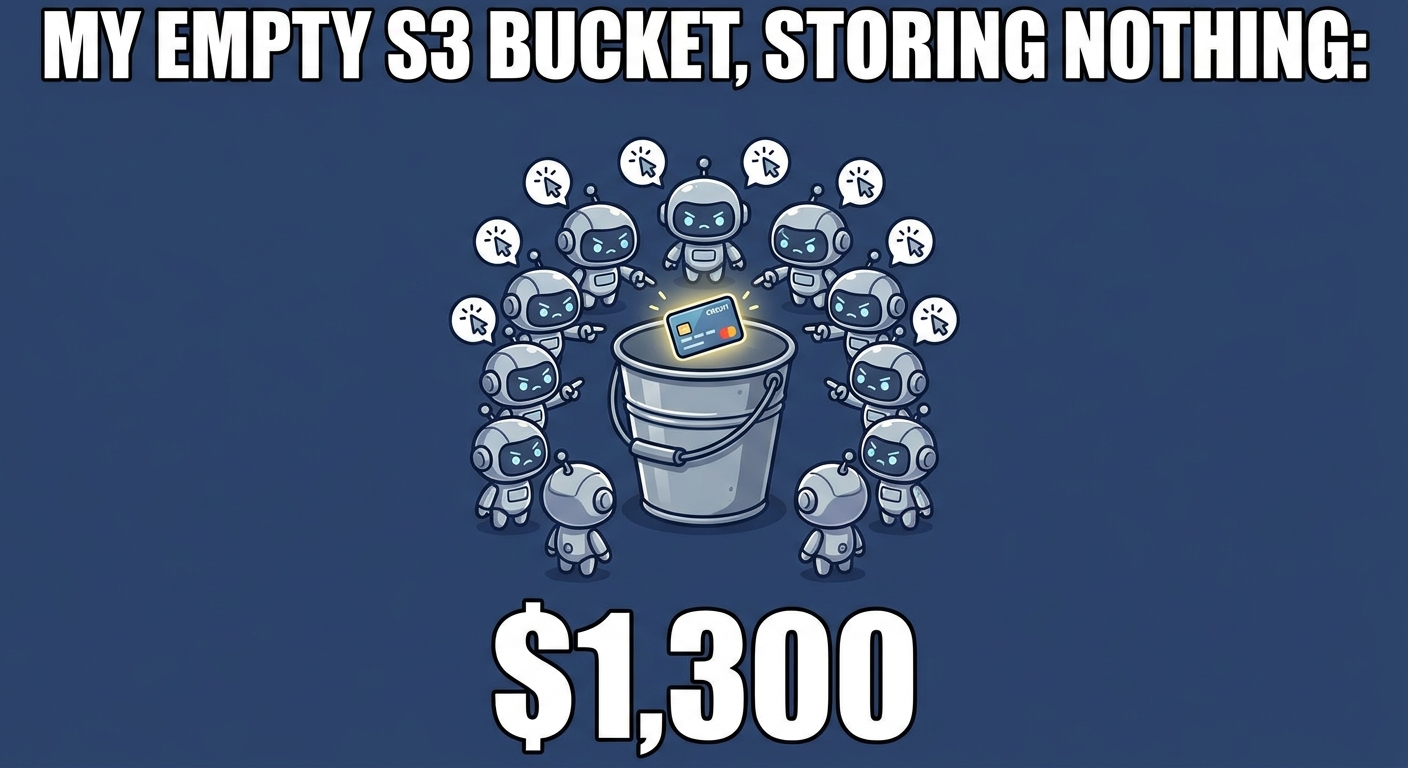
The internet has write access to your AWS bill, and there is no spending cap to stop it.
To AWS's credit, they moved fast. They waived his bill, and — prompted by exactly this story — AWS announced it would stop charging for unauthorized requests (HTTP 4xx) that you didn't initiate. The acknowledgment came straight from the top:
Thank you to everyone who brought this article to our attention. We agree that customers should not have to pay for unauthorized requests that they did not initiate. We’ll have more to share on exactly how we’ll help prevent these charges shortly.
— Jeff Barr ☁️ (@jeffbarr) May 1, 2024
But the deeper lesson outlived the patch.
The pattern: you are billed for traffic you can't refuse
This is the same shape as every cloud-cost horror story: the meter runs on things outside your control, and nothing stops it at a number. A leaked key. A misconfigured tool. A bot storm. A bucket name in someone's default config. The cost arrives first as silence, then as a statement.
You can't prevent the internet from sending you requests. What you can do is put a floor under the damage:
- Make names unguessable — add entropy to bucket names; don't use
company-prod. - Watch spend in real time, not at invoice time. A bucket getting hammered is a spend curve that bends upward hours before the bill lands.
- Have a circuit breaker. The difference between a $40 surprise and a $40,000 one is whether something was watching and able to act while it was still small.
That last one is why we built Kill Switch: it watches your cloud spend and trips before a runaway becomes a five-figure invoice — because AWS won't give you a hard ceiling, so you have to bring your own. Free tier, one account. An empty bucket shouldn't be able to bankrupt you. Until the cloud agrees, watch the meter.